

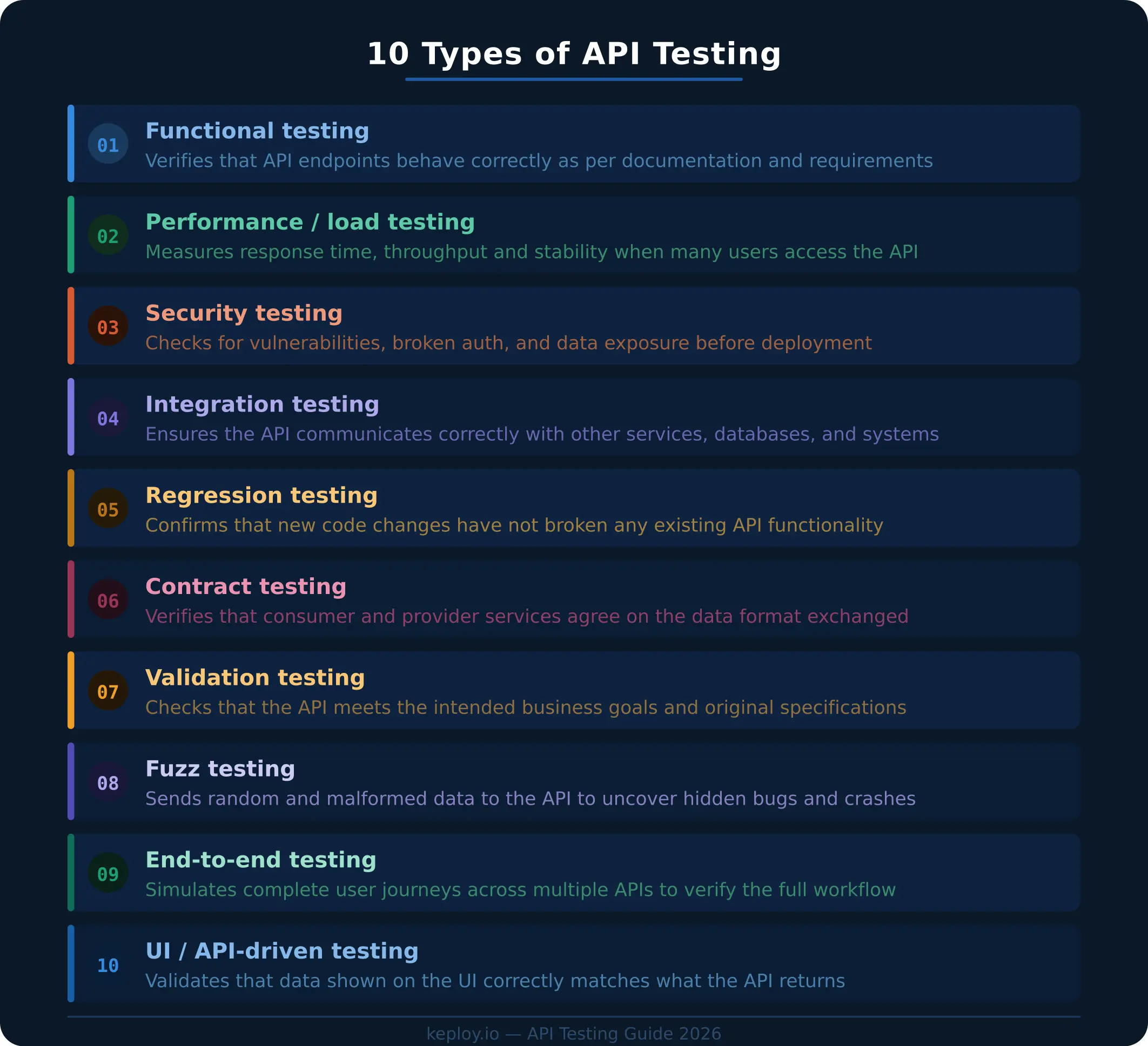
APIs are the backbone of modern software. From mobile apps fetching data to microservices communicating with one another, APIs are everywhere. But with great power comes great responsibility — and that responsibility begins with rigorous API testing.
Whether you’re a QA engineer, a backend developer, or a DevOps professional, understanding the different types of API testing is essential to shipping reliable software. This guide walks you through each type, what it checks, and why it matters.
What Is API Testing?
API testing is a form of software testing that validates the functionality, reliability, performance, and security of application programming interfaces. Unlike UI testing, API testing operates at the business logic layer — directly communicating with the API without a user interface in the loop.
The goals are simple: ensure the API does what it’s supposed to do, handles edge cases gracefully, responds fast enough, and doesn’t expose security vulnerabilities.
10 Types of API Testing
1. Functional Testing
Functional testing verifies that an API behaves exactly as documented. It checks endpoints for correct responses, validates request/response structures, and ensures business logic is implemented properly.
What it checks:
- Correct HTTP status codes (200, 201, 400, 404, 500, etc.)
- Accurate response payloads
- Proper handling of valid and invalid inputs
- CRUD operations working as expected
Example: Calling a POST /users endpoint and verifying the response includes a valid user ID and a 201 Created status.
2. Integration Testing
APIs rarely exist in isolation. Integration testing ensures that different services, databases, and third-party APIs communicate correctly with each other when wired together.
What it checks:
- Data flows correctly between connected systems
- APIs consume and produce data in compatible formats
- External service integrations (payment gateways, email services) work end-to-end
Example: Testing that a checkout API correctly communicates with the inventory service to decrement stock after a successful order.
3. Load Testing
Load testing measures how an API performs under expected traffic conditions. It simulates a realistic number of concurrent users to identify performance baselines.
What it checks:
- Response times under normal load
- Throughput (requests per second)
- Resource consumption (CPU, memory)
Tools: Apache JMeter, k6, Locust
Example: Simulating 500 concurrent users hitting a GET /products endpoint to ensure average response time stays under 200ms.
4. Stress Testing
Stress testing pushes the API beyond its limits to find its breaking point. Unlike load testing, the goal here is deliberate overload — to see how the system fails and whether it recovers gracefully.
What it checks:
- Behavior under extreme load
- Crash recovery and error messages
- System stability when resources are exhausted
Example: Gradually ramping up requests to 10,000 concurrent users to observe when the server starts returning 503 errors and how quickly it recovers.
5. Security Testing
Security testing uncovers vulnerabilities in an API that could be exploited by malicious actors. This is one of the most critical types, especially for APIs handling sensitive data.
What it checks:
- Authentication and authorization flaws
- SQL injection and input validation
- Sensitive data exposure in responses
- Rate limiting and brute-force protection
- OWASP API Security Top 10 compliance
Example: Attempting to access a GET /admin/users endpoint with a non-admin token to verify the API correctly returns a 403 Forbidden response.
6. Validation Testing
Validation testing ensures the API conforms to its specification — whether that’s an OpenAPI/Swagger spec, a JSON schema, or a contract document. It’s about correctness of structure, not just behavior.
What it checks:
- Response schemas match the documented contract
- Data types are correct (e.g., string vs. integer)
- Required fields are always present
- Deprecated endpoints are properly handled
Example: Validating that every GET /orders/{id} response always contains id, status, created_at, and total fields as declared in the OpenAPI spec.
7. Runtime / Error Detection Testing
This type focuses on detecting runtime errors — issues that only emerge when the API is actually executing under real conditions, such as memory leaks, unhandled exceptions, or crashes.
What it checks:
- Unhandled exceptions and stack traces
- Memory and resource leaks over time
- Graceful error responses (no raw stack traces exposed to users)
Example: Repeatedly calling an endpoint with malformed payloads and checking whether the server leaks implementation details in the error response.
8. Penetration Testing
Often called “pen testing,” this is a simulated cyberattack against the API to find exploitable security gaps before real attackers do. It goes deeper than standard security testing.
What it checks:
- Broken object-level authorization (BOLA/IDOR)
- Broken function-level authorization
- Mass assignment vulnerabilities
- API key and token leakage
Example: Using tools like Burp Suite or OWASP ZAP to probe for authorization bypass vulnerabilities across different user roles.
9. Fuzz Testing
Fuzz testing (or fuzzing) bombards an API with random, unexpected, or malformed inputs to discover how it handles unpredictable data. It’s a powerful technique for uncovering edge-case bugs and crashes.
What it checks:
- Unexpected input handling
- Edge cases that developers didn’t anticipate
- Memory corruption or denial-of-service vulnerabilities
Example: Sending thousands of randomly generated strings, extreme integer values, and special characters to a POST /search endpoint to find any that crash the server.
10. Contract Testing
Contract testing verifies that the API respects agreements (contracts) between service providers and consumers. This is especially critical in microservices architectures where teams independently own services.
What it checks:
- Provider APIs conform to consumer expectations
- Changes to an API don’t silently break downstream consumers
- Consumer-driven contracts are honored
Tools: Pact, Spring Cloud Contract
Example: A frontend team defines a contract for the GET /profile endpoint; contract testing ensures the backend team’s implementation always satisfies that contract.
Why API Testing Matters
|
Benefit |
Impact |
|
Early bug detection |
Fewer issues in production |
|
Performance baselines |
Better capacity planning |
|
Security assurance |
Reduced attack surface |
|
Faster CI/CD pipelines |
Faster, safer deployments |
|
Cross-team alignment |
Fewer integration surprises |
Choosing the Right API Testing Tools
- Postman — Best for functional and exploratory testing
- Keploy — AI-powered automated API testing and test generation
- k6 / JMeter — Load and stress testing
- OWASP ZAP / Burp Suite — Security and penetration testing
- Pact — Contract testing in microservices
- REST Assured — Java-based API test automation
Best Practices for API Testing
- Test early and test often — Integrate API tests into your CI/CD pipeline from day one.
- Use real-world data — Edge cases in production data expose bugs that synthetic data misses.
- Automate repetitive tests — Regression suites should run on every commit.
- Don’t neglect negative testing — Invalid inputs, missing headers, and unauthorized requests reveal more than happy-path tests.
- Document your API — A well-maintained OpenAPI spec makes validation and contract testing dramatically easier.
- Monitor in production — Testing doesn’t stop at deployment; synthetic monitoring catches regressions in live environments.
Final Thoughts
API testing isn’t a single discipline — it’s a spectrum of techniques, each targeting a different layer of risk. Functional testing ensures correctness. Load testing ensures performance. Security testing ensures safety. Contract testing ensures collaboration.
The best API testing strategy combines multiple types, runs automatically, and integrates tightly with your development workflow.
To dive deeper into each of these testing types with practical examples and tool recommendations, check out this comprehensive resource: Types of API Testing by Keploy.
Have questions about API testing or want to explore automated test generation? Start with Keploy — an open-source tool that records API calls and auto-generates tests from real traffic.