

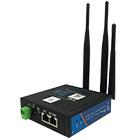
In today’s fast-paced digital world, connectivity is the backbone of industries. Whether it’s manufacturing, automation, transportation, or energy management, stable and secure internet communication is essential. This is where the industrial router plays a critical role. Unlike ordinary home routers, an industrial router is designed specifically to function in harsh environments while ensuring reliable data transmission, 24/7 connectivity, and secure network access. In this article, I’ll explain what an industrial router is, how it works, its key benefits, and why businesses should invest in one.
What Is an Industrial Router?
An industrial router is a high-performance networking device engineered to withstand extreme conditions such as heat, dust, humidity, vibration, and power fluctuations. While standard routers are built for home or office use, an industrial router is built for factories, smart cities, remote sites, and other industrial applications.
These routers support advanced technologies like 4G/5G, Ethernet, Wi-Fi, VPN, Modbus, and IoT protocols, making them perfect for machine-to-machine (M2M) communication and remote monitoring systems.
How Does an Industrial Router Work?
The working process of an industrial router is similar to that of a traditional router but with more robustness and advanced configurations:
-
Data Transmission:
It receives digital data from sensors, machines, or computers and sends it securely to servers or cloud platforms. -
Multiple Connection Types:
An industrial router can connect through Ethernet cables, fiber optics, 4G/5G SIM cards, or wireless networks. -
Secure Communication:
It supports VPN, firewalls, and encryption to protect the network from cyber threats. -
Remote Access and Control:
Businesses can monitor and manage devices remotely using web interfaces or software platforms connected through the industrial router.
Why is an Industrial Router Essential?
An industrial router is essential for industries because it ensures:
-
Continuous Internet Access: No breakdowns, even in tough environments.
-
Secure Data Flow: Advanced cybersecurity features keep sensitive data safe.
-
Remote Monitoring: Operators can control machines from anywhere.
-
Efficient Automation: Supports IoT systems and smart factory operations.
Key Features of an Industrial Router
Industrial routers are packed with advanced features. Some of the most notable ones include:
-
Rugged Design:
Designed to work in temperatures between -40°C to 75°C, resist dust, shocks, and vibrations. -
Multiple Network Support:
Works with Ethernet, Wi-Fi, 4G/5G, DSL, and even satellite communication. -
Advanced Security:
Features like VPN, IPsec, OpenVPN, firewalls, and SSL/TLS encryption. -
Dual SIM and Failover:
With dual SIM support, the industrial router automatically switches between networks if one fails. -
DIN Rail Mounting:
Easy installation inside control cabinets in industrial environments. -
IoT and M2M Compatibility:
Supports protocols like MQTT, Modbus, OPC-UA, perfect for Industrial Internet of Things (IIoT).
Applications of Industrial Router
An cellular router is used in various fields because of its versatility and high durability. Some key applications include:
| Industry | Use of Industrial Router |
|---|---|
| Manufacturing | Machine monitoring and automation |
| Smart Cities | Traffic lights, surveillance cameras |
| Energy Sector | Wind turbines, solar farms, oil & gas monitoring |
| Transportation | Vehicle tracking, fleet management |
| Agriculture | Smart irrigation, greenhouse monitoring |
| Retail | ATM machines, POS systems, digital signage |
Benefits of Using an Industrial Router
Using an industrial router brings multiple advantages to modern businesses:
-
Uninterrupted Connectivity:
Ensures smooth operations, reducing production delays. -
Better Data Management:
Machines and sensors send real-time information for faster decision-making. -
Enhanced Safety:
Secures industrial networks from cyber-attacks and unauthorized access. -
Cost-Effective:
Reduces the need for constant manual monitoring and maintenance. -
Scalability:
Works perfectly for both small setups and large industrial networks.
Industrial Router vs Standard Router
| Feature | Industrial Router | Standard Router |
|---|---|---|
| Environment | Harsh, extreme conditions | Home or office |
| Connectivity | 4G/5G, Ethernet, IoT | Wi-Fi, Ethernet |
| Security | VPN, Firewall, Encryption | Basic WPA/WPA2 |
| Durability | High resistance to heat, dust, vibrations | Not suitable for industrial use |
| Remote Access | Advanced remote management | Limited |
Tips for Choosing the Best Industrial Router
If you plan to buy an industrial router, consider these points:
-
Check if it supports 4G/5G or fiber connectivity.
-
Make sure it has dual SIM failover for backup networks.
-
Look for IoT-compatible protocols (Modbus, MQTT, OPC-UA).
-
Ensure it comes with strong cybersecurity features.
-
Choose a router with remote management and cloud support.
Conclusion
In conclusion, an industrial router is a crucial device for industries that rely on automation, secure communication, and real-time data exchange. It offers high durability, strong security, and uninterrupted connectivity — features that make it far superior to regular home routers. From factories to agriculture, smart cities to transportation systems, the industrial router has become an essential component of modern industrial infrastructure.
Investing in a reliable industrial router not only boosts productivity but also supports innovation and technological growth. If your business depends on continuous data flow and remote monitoring, this device is exactly what you need.