

Hammer Candlestick Pattern: A Beginner-Friendly Guide to Spotting Market Trends
Introduction
Have you ever tried looking at a candlestick chart and thought, “Wow, this looks like a secret code!” You’re not alone. Candlestick patterns can feel intimidating at first, but the truth is—they are simply powerful stories about price movement. Among the countless candlestick patterns, the hammer candlestick pattern and the inverted hammer candlestick pattern are among the most beginner-friendly and effective tools traders use worldwide.
Think of these candlestick patterns as signals from the market. They help you understand where buyers and sellers are pushing prices, giving you a clue about potential reversals. If you’ve ever wished for a trading “cheat sheet,” this is it!
In this detailed guide, we’ll break down everything you need to know in simple, human language. No heavy jargon, no overwhelming technical theories. Just straightforward explanations about hammer candlesticks, inverted hammers, and how to use them in your trading journey.
Learn the hammer candlestick pattern, inverted hammer candlestick pattern, and their role in trading. Perfect for beginners seeking a course for trading.
What is a Hammer Candlestick Pattern?
A hammer candlestick pattern is one of the most common reversal signals in technical analysis. It usually shows up after a downtrend and suggests that the market might be about to turn upward.
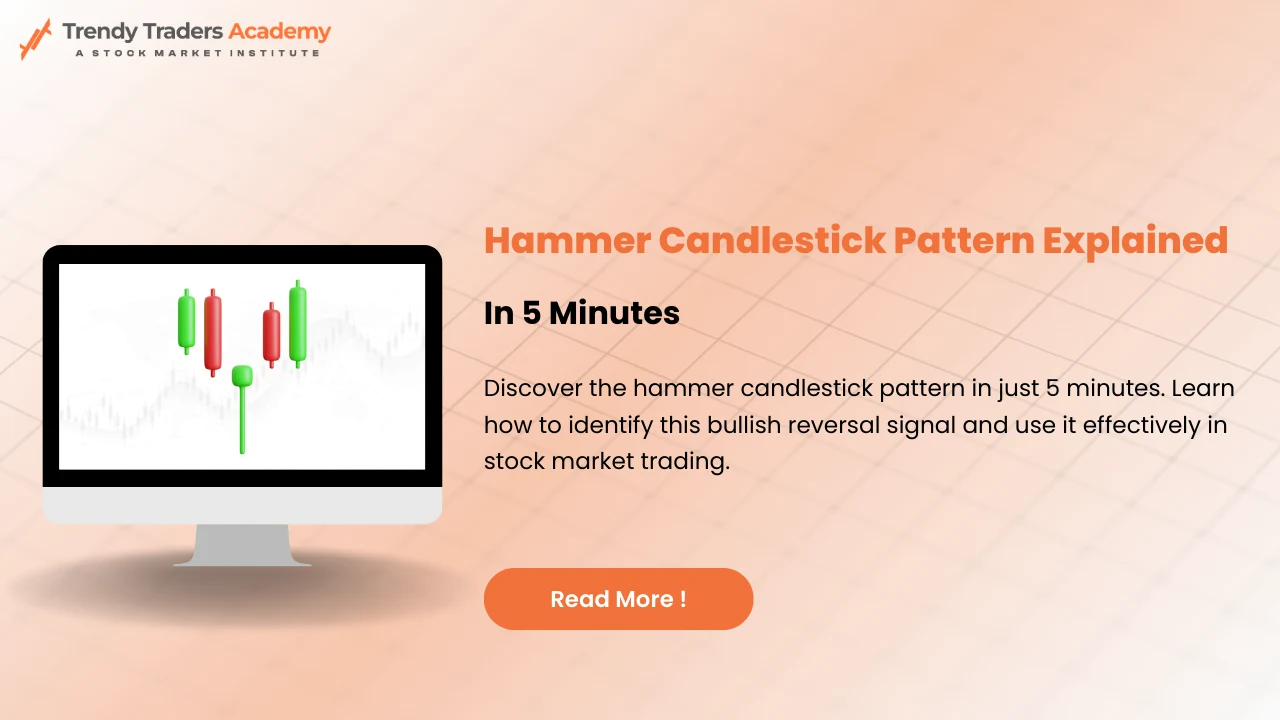
The candle looks like a hammer—small body at the top, with a long “handle” or shadow sticking down. Just like a real hammer drives nails into a surface, this candlestick signals the market may drive itself upward after hitting a “low point.”
Anatomy of a Hammer Candle
Here’s what makes up a proper hammer:
- Small Real Body: Near the top of the candle, showing buyers managed to push the price back up.
- Long Lower Shadow: At least twice the size of the real body, representing sellers were strong at first, but then buyers regained control.
- Little or No Upper Shadow: Indicating limited selling pressure from above.
Think of it like a tug-of-war where sellers were winning initially, but buyers came back and took the rope away at the last moment.
What Does a Hammer Candlestick Indicate?
This pattern signals bullish reversal potential. If you see a hammer after several red candles, it suggests sellers are losing steam and buyers are stepping in.
In simple words: it’s a sign that the downtrend may be running out of fuel.
Difference Between Hammer and Inverted Hammer Candlestick Pattern
- Hammer (Regular): Appears at the bottom of a downtrend. It has a long lower shadow. Signals a reversal upward.
- Inverted Hammer Candlestick Pattern: Has a long upper shadow with a small body at the bottom. It also shows up after a downtrend but indicates buyers are testing control.
Analogy: Imagine a door being pushed open. The hammer is like someone pushing from the bottom and succeeding, while the inverted hammer is like someone testing from the top but not yet fully breaking in.
Identifying a Real vs. Fake Hammer
Not every candlestick with a “stick” at the bottom is a hammer! To identify a valid hammer:
- The lower shadow must be at least 2x longer than the body.
- The body should be near the top of the range.
- Volume should often confirm the reversal—it’s like voices backing up the price action story.
Examples of Hammer in Bullish Reversal
Suppose a stock has been falling for 5 days straight, printing red candles. On the 6th day, it forms a hammer. The next day, the stock opens higher. This is a typical real-life hammer reversal example traders love to see.
Understanding Inverted Hammer Candlestick Pattern
The inverted hammer candlestick pattern is often misunderstood. It occurs at the end of a downtrend, but unlike the hammer, it has a long upper shadow. This shows buyers pushed prices higher during the session, even if sellers brought it back down a bit.
It’s more like a warning bell than a strong confirmation. Smart traders wait for a green candle after the inverted hammer to confirm the reversal.
When to Trust the Inverted Hammer?
An inverted hammer becomes credible when:
- It forms after a downtrend.
- The next candle closes higher than the inverted hammer’s close.
- Trading volume supports it.
Hammer Patterns vs. Doji Patterns
Some beginners confuse hammers with doji candlesticks (candles where open and close prices are nearly equal).
- Hammer: Has a clear small body and long shadow.
- Doji: Has barely any body.
In short, a hammer suggests buyer strength, while a doji suggests indecision.
Hammer Candlestick in Day Trading
Day traders love hammer patterns because they can provide quick reversal insights. For example:
- Spot a hammer at a support level → consider buying.
- Spot a hammer at a resistance level (rare case) → might hint at short-term reversal.
How to Trade Hammer Candlesticks Step-by-Step
Here’s a simple strategy for beginners:
- Find a Hammer: Look for one at the bottom of a downtrend.
- Confirm with Volume: Bigger volumes mean stronger signals.
- Wait for Next Candle: If it closes higher, that’s your entry signal.
- Set Stop Loss: Place it just below the hammer’s low.
- Decide Exit Point: Either at resistance level or when you’ve hit your profit target.
Risk Management with Hammer Patterns
Even the best patterns fail sometimes. That’s why traders use stop-loss orders and don’t risk more than 1–2% of their capital per trade. Always remember—the hammer is a tool, not a guarantee.
Common Mistakes Traders Make with Hammers
- Entering the trade without confirmation from the next candle.
- Ignoring context: A hammer in the middle of nowhere (without support/resistance) is weaker.
- Over-leveraging: Treating every hammer as a “sure win.”
Course for Trading: Why You Need One
While articles like this give you the basics, if you’re serious about trading, enrolling in a course for trading is invaluable. Courses teach not just candlestick patterns, but also risk management, psychology, and advanced strategies. It’s like learning to drive a car—not just about pressing the accelerator, but also about road rules and safety.
Final Thoughts and Key Takeaways
The hammer candlestick pattern and the inverted hammer candlestick pattern are excellent starting points for beginners. They reveal market psychology in a way that’s easy to spot, even for new traders.
Remember:
- Hammer = bullish reversal at bottom.
- Inverted Hammer = potential reversal (needs confirmation).
- Use them with volume and other indicators.
- Always practice smart risk management.
Trading becomes less of a gamble and more of a skill when you learn to combine these tools wisely.
FAQs
- Is the hammer candlestick pattern always accurate?
No, while powerful, it needs confirmation and works best with other signals. - What is the difference between a hammer and hanging man?
Though they look the same, a hammer occurs after a downtrend (bullish), while a hanging man appears after an uptrend (bearish). - Can I use hammer candlestick patterns for forex and crypto trading?
Yes! These patterns work across all markets—stocks, forex, crypto, and commodities. - Do I need special software to spot hammer candlestick patterns?
No, any basic charting platform like TradingView or even broker-provided charts will show candlesticks. - Should I rely only on candlestick patterns to trade?
Never. Use them with technical indicators, volume, and risk management for better results.